
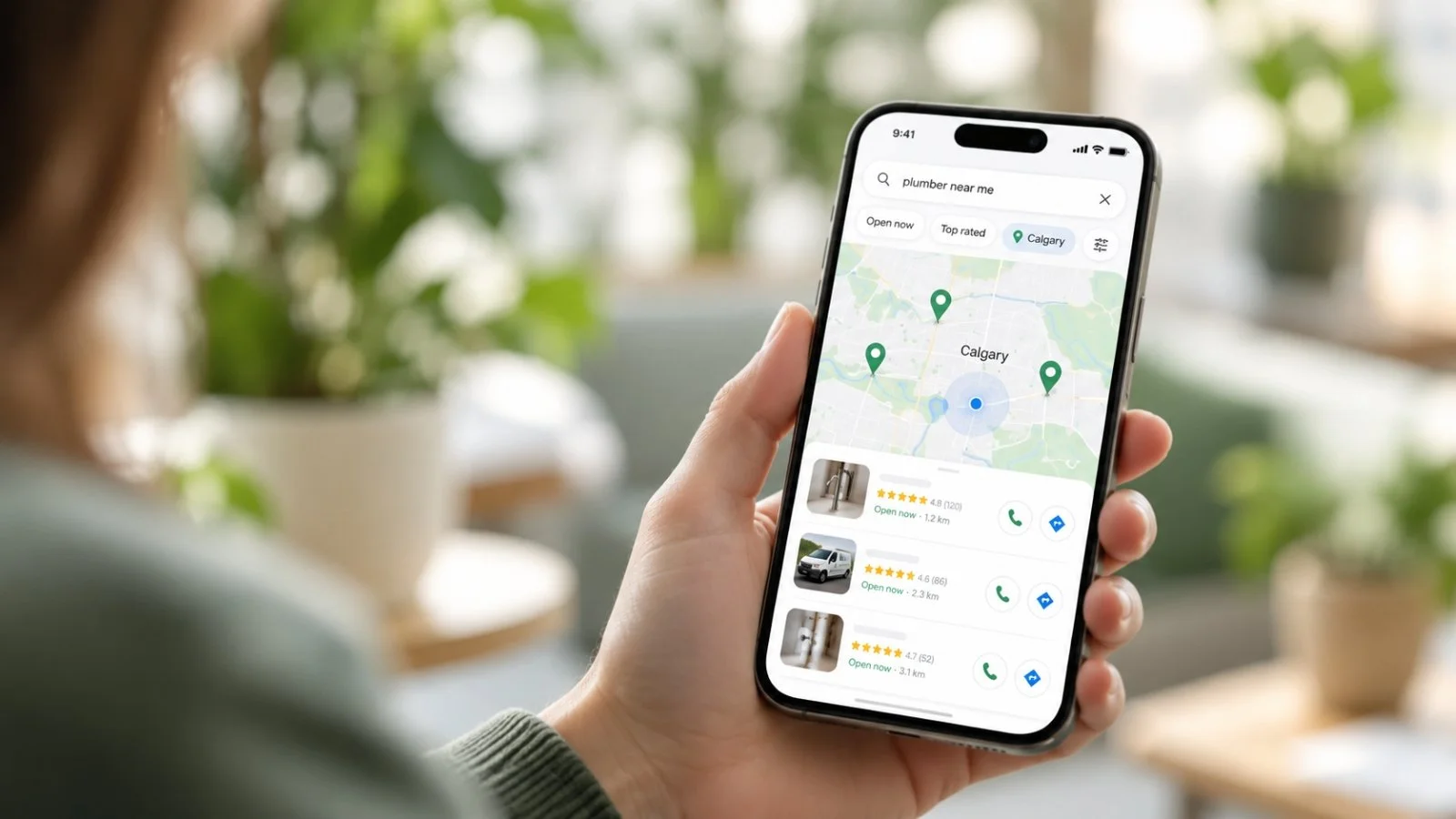
Someone in your area needs a service you offer. They pull out their phone, search for a nearby business, and find several options on Google Maps. Your business might be a good fit, but it won't make their shortlist if they never come across it.
Local SEO for small business starts with a simple question: what do people actually find when they search for you? Check your Google Business Profile first. Are your hours and contact details correct? Look at your reviews, too. Then visit your website and see whether someone unfamiliar with your business could quickly figure out what you offer and where you work.
Key Takeaways
Local SEO for small businesses is about making sure nearby customers can find you on Google Maps and in local search results.
Search for the same service in different parts of a city, and you may see different businesses. How closely a business matches the search, how far away it is, and how well-known it is all play a part.
Take another look at your Google Business Profile. Are your opening hours, contact details, and listed services still correct? Make sure your photos reflect your business, too.
A five-star rating doesn't tell the whole story. Customers may also look at recent reviews, what people say about the service, and how a business handles complaints.
Someone visiting your website should be able to tell whether you handle the job they need, serve their area, and how to get in touch.
Track profile views, calls, website visits, and customer inquiries to understand whether local search visibility is leading to business opportunities.
What Is Local SEO for Small Business?
With local SEO for small business, the aim is to help nearby customers find you when they need what you offer. Take someone looking for a plumber in Edmonton. They aren't searching for just any plumbing company. They need one that handles the job and serves their area.
A business won't necessarily appear in the same place for every local search. Google Maps lets people check which businesses are nearby, where they're located, and whether they're open. A regular Google search may show the Google Map Pack, which places several local business listings directly on the results page.
Business websites can also appear in the organic search results outside those map listings. Try searching for your business on Google Maps, then look for it in the regular search results.
What Affects Your Business's Local Search Ranking?
Search for an electrician in two different parts of the same city, and you may get different results. Three things help explain why: relevance, distance, and prominence. Google considers all three when determining local search rankings.
Say you need someone to install a new electrical panel. Relevance comes down to whether an electrician offers that service. You might find an electrician who does exactly that work, only to discover they're on the other side of town. Distance is part of Google's calculation, too. Then there's prominence, which is partly about how well-known a business is. Google also considers reviews and links from other websites.
For near me searches, the searcher's location can make a noticeable difference in which businesses appear. These local ranking factors work together. A business cannot simply pay Google for a better position in local results.
Getting Your Google Business Profile Right
Your Google Business Profile gives customers practical details about your business before they visit your website. A useful starting point for Google Business Profile optimization is checking whether those details are accurate and complete.
Start with your primary business category. It should describe what your business actually does, not every service you hope to appear for. Check your services against what you actually offer. An old phone number, incorrect website link, or outdated opening hours can send customers in the wrong direction. If customers visit your premises, verify the address.
For businesses that travel to customers, review the service-area settings instead. If customers can't visit your business address, check whether it should be hidden from your public profile.
A contractor's project photos can show the type of work customers might hire them for. If you run a storefront, show people what they'll see when they arrive, from the entrance to the inside of the shop. Actual photos are more helpful here than stock images, especially if the place has changed since the pictures were taken.
Holiday hours are easy to overlook, especially when your regular schedule hasn't changed. Before a holiday comes around, take another look at your listing. Are the hours still right? Has Google suggested an edit you haven't checked? It's also worth catching an old phone number or website link before a customer tries to use it.
Why Google Reviews Matter Beyond Star Ratings
Did the contractor show up on time? Was the customer happy with the finished work? Those details in Google reviews can tell someone more than a five-star rating. Reviews about workmanship or how a business handled a complaint may also answer questions before a customer decides to call.
Review dates matter, too. Feedback from last month may tell a customer more about a business's current service than comments posted several years ago. Still, one recent review doesn't erase a longer history of positive or negative experiences.
Ask customers for honest reviews, including those who may have had a less-than-perfect experience. Don't offer rewards in exchange for reviews or selectively request positive feedback. When a complaint appears, respond to the concern directly without sharing private customer details.
Your Website's Role in Local Search
A Google Business Profile can introduce someone to your business, but your website needs to answer the questions that follow. Can you handle the job they need done? Do you serve their area?
For example, a plumbing company working on its local SEO in Edmonton should make its services and service areas clear on relevant pages. Someone looking for drain cleaning needs more than a list of cities. They need to know whether the company handles that problem and serves their location.
Good website development supports this information with clear navigation and pages that are easy to use on a phone. For a service business, clear page titles, useful descriptions, and an easy-to-find contact option can help visitors decide what to do next.
Adding city names throughout a page is not a substitute for useful content. The information should reflect where the business actually works and what customers can expect.
Measuring What Your Local SEO Efforts Achieve
Getting more visibility in local search is useful, but it helps to know whether people are taking the next step.
Start with your Google Business Profile performance data. Profile views show how often people saw your listing. Calls, website clicks, and direction requests tell you what they did next. For your website, look at which service pages attract visitors and whether those visits lead to inquiries.
Compare results month to month, not just week to week. If your profile views increase but inquiries stay flat, the extra visibility hasn't translated into more customer conversations. Whether you manage SEO yourself or pay for SEO services, track inquiries, booked appointments, and sales alongside your search and website data.
Make It Easier for Local Customers to Find You
The first thing to check with local SEO for small business is whether customers can actually find the right information about you. Look up your services on Google and see what appears. Can they tell what you offer, where you work, and how to reach you? If any of those answers are unclear, that's a useful place to begin.
Improving local search visibility takes ongoing attention, but the goal is straightforward: help the right people find reliable information about your business when they need it.
Not sure where your business stands in local search? For help with local SEO in Calgary or elsewhere in Alberta and British Columbia, contact Wild Visibility to talk about your current visibility and where there's room to improve.